Crypto Weekly Market Wrap June 22 – Treasury Buys, Regulatory Shifts, ETF Outflows and Market Performance


Last week, the crypto market saw major treasury buys, regulatory changes, token recovery plans, and infrastructure changes. Institutions increased their exposure to Ethereum and Bitcoin while governments ramped up oversight in Europe, Asia, and the United States. Meanwhile, blockchain teams have advanced staking, tokenization, quantum security, and network upgrades. Here’s a look at the week’s major headlines.
BitMine Acquires 76,881 ETH for Treasury Expansion
BitMine Immersion Technologies added 76,881 ETH during the week ending June 14. The purchase cost about $136 million. As a result, total holdings reached 5,620,754 ETH, representing roughly 4.66% of Ethereum’s supply. The company staked 4,718,677 ETH and reported a 2.79% annualized weekly yield. It also held 204 BTC and $502 million in cash and marketable securities. Its portfolio included stakes in Beast Industries and Eightco Holdings.
Advertisement

Strategy Adds Bitcoin Through a Smaller Weekly Purchase
Strategy acquired 1,587 BTC for $100 million last week. On June 15, Michael Saylor said the company paid an average of $63,024 per coin. Therefore, total holdings increased to 846,842 BTC, acquired for about $64.07 billion. The latest deal marked Strategy’s second consecutive purchase near $100 million. The company funded the transaction through common stock sales and issued no preferred shares during the week.
During BTC Prague 2026, Michael Saylor described Bitcoin as digital capital. He argued that Bitcoin could anchor digital credit, money, yield, equity, and wider financial services as adoption grows. Saylor also projected that the network could eventually reach $100 trillion. Moreover, he outlined a price path from $70,000 to $700,000 and then $7 million. His remarks presented Bitcoin as infrastructure for a broader financial system.
Meanwhile, Michael Saylor defended Strategy’s treasury model after STRC preferred shares fell below their $100 par target. He linked the criticism to the company’s severe market pressure during late 2022.
When I gave this speech in October 2022, Bitcoin traded near $20,000, Strategy held 130,000 BTC worth about $2.6 billion, and $MSTR was ~$24 split-adjusted. Weeks later, after Bitcoin fell below $16,000, our debt exceeded the combined value of our BTC and cash reserves by ~$300… pic.twitter.com/nWl9YlN11s
— Michael Saylor (@saylor) June 20, 2026
At that time, debt exceeded Bitcoin and cash reserves by about $300 million. However, Strategy kept its holdings and continued raising capital. Saylor said reserves now exceed debt by around $48 billion after more than $60 billion in financing. The defense aimed to address the ongoing scrutiny.
Senators Seek Clearer State Role Under GENIUS Act
A group of United States senators urged the Treasury to preserve state participation in stablecoin oversight. Their June 16 letter asked Secretary Scott Bessent for clear certification rules. Senator Cynthia Lummis’s office released the document.
The lawmakers said states lacked a timeline and a detailed application process. Moreover, they opposed a one-time certification window. They argued that states should apply their laws whenever they become ready nationwide. Annual recertification, they said, supports an ongoing process.
Humanity Protocol Replaces Token After Major Exploit
On June 16, Humanity Protocol announced a replacement for its H token after a $36 million exploit on June 8. The project aims to airdrop it at 1:1, employing a newly audited ERC-20 token. Balances will be given to eligible wallets as per a snapshot taken prior to the attack.
Meanwhile, attacker-linked addresses will receive nothing. They are also contemplating a mainnet restart and a claims fund, as well as identity screening for claims related to post-snapshot buyers or integrations. The move supplements the overall process of recovery addressed by the project.
Bank of Japan Raises Policy Rate Again
On June 16, the Bank of Japan raised its policy rate by 25 basis points after a 7-1 board vote. The target for the overnight call rate increased to about 1.0%. The new rate took effect on June 17 and reached its highest level in roughly 31 years. Meanwhile, the central bank warned that higher crude oil costs could lift consumer prices throughout the economy. It said underlying inflation could potentially exceed its 2% target.
Illinois Introduces Transaction Tax for Digital Assets
In the Fiscal 2027 budget, Illinois enacted a 0.2% tax on covered digital asset transactions. On June 17, Governor JB Pritzker signed the $55.9 billion spending plan, which includes Senate Bill 3019. The tax will apply beginning January 1, 2027, to exchanges, transfers, custody, and wallet activity. Brokers are required to register, collect the charge separately, and submit monthly reports. In addition, the same requirements will apply to qualifying out-of-state platforms. The threshold applies to qualifying out-of-state brokers.
World Liberty Moves Closer to Federal Charter
On June 17, World Liberty Financial edged closer to an OCC federal trust bank charter. The approval would bring its USD1 stablecoin business under federal supervision. Approval was seen as probable within days, former OCC officials said.
𝗝𝗨𝗦𝗧 𝗜𝗡: World Liberty Financial is reportedly close to receiving approval for a federal trust banking charter from the Office of the Comptroller of the Currency (OCC). pic.twitter.com/dzv5jVN9LP
— Blockto (@CryptoBlockto) June 17, 2026
If approved, the charter would allow World Liberty to issue and redeem USD1 directly. It could also be used for reserves, custody assets, and settlement services. As a result, the firm could lessen dependence on state authorizations and the BitGo issuance role.
Oman Launches National Bitcoin Mining Pool
On June 17, Oman launched Omanhash as the country’s official Bitcoin mining pool. The communications ministry partnered with Frontier Technologies, while Enegix supplied platform and liquidity infrastructure. Licensed mining companies must connect to the pool under Oman’s regulatory framework. Initially, Omanhash expects to combine about 10 EH/s of computing power. The country has invested more than $700 million in mining and data centers since 2022. The launch centralizes licensed mining activity under one official national structure.
Binance Considers France After Greek MiCA Setback
Binance reportedly sought MiCA approval in France after a Greek application rejection. France is now the main remaining route for the exchange into regulated European operations, said the Big Whale. Binance discussed the matter with France’s AMF but has not filed officially. Its French entity is already registered locally, but MiCA approval is not guaranteed. The June 30 deadline also puts pressure on the exchange. Binance’s first choice is still France.
Bybit Responds to Singapore Investor Alert Listing
Singapore’s Monetary Authority added Bybit and Bybit Fintech Limited to its Investor Alert List on June 17. The listing indicates that the exchange lacks authorization to solicit local residents. Bybit said it already blocks Singapore users and restricts local IP addresses. Moreover, its terms prohibit residents from accessing services. The exchange said it has contacted MAS for clarification and will continue engaging with regulators about the decision. Bybit maintained its stated access restrictions.
CZ Urges Asian Governments to Tokenize Markets
Binance co-founder CZ said he met several Asian leaders and regulators about cryptocurrency cooperation. On June 17, CZ encouraged governments to support tokenized stocks and other real-world assets.
CZ argued that tokenization could open domestic equities to global trading. Additionally, he urged countries to issue local currency stablecoins. Such products could expand fiat use across blockchain networks and support broader digital market participation under national regulatory strategies. He presented both measures as practical national adoption tools.
CME Plans Lawsuit Over Perpetual Futures Approval
In June, CME Group prepared legal action against the CFTC over its approval of cryptocurrency perpetual futures. Outgoing chief executive Terrence Duffy said the company would challenge the agency’s classification. Duffy argued that perpetual contracts resemble swaps under the Dodd-Frank Act rather than futures. Therefore, he believes they require another regulatory framework. CME’s board supports the lawsuit, and internal discussions continued for eight months before the planned filing. CME expects a potentially lengthy legal battle.
Morgan Stanley Sets Low Fees for Crypto ETFs
Morgan Stanley amended filings for proposed Ethereum and Solana exchange-traded funds on June 18. Both products would charge a 0.14% annual sponsor fee and hold their underlying tokens directly.
NEW: @MorganStanley just filed amendments for both their Ethereum and Solana ETFS. ethereum:native solana:So11111111111111111111111111111111111111112 pic.twitter.com/SxPiszp9RS
— James Seyffart (@JSeyff) June 18, 2026
The trusts would also stake some assets and retain 95% of related rewards. Providers would receive the remaining 5%. Meanwhile, the Ethereum fund would trade as MSSE, while the Solana product would use the MSOL ticker. Both products follow proposed staking structures.
Ireland Raises Crypto Financial Crime Risk Rating
Ireland identified crypto assets as a very significant money laundering and terrorist financing risk on June 18. The rating for both categories was increased from medium-high by the National Risk Assessment Ireland 2026.
Authorities cited pseudonymous, fast cross-border transfers, mixers, decentralized finance, and peer-to-peer activity. Moreover, law enforcement noted increased use of cryptography in criminal cases. The assessment requires firms to enhance the monitoring, customer checks, and reporting of suspicious activity as required by MiCAR.
South Korea Plans Oversight for Crypto Transfers
On June 19, South Korea released instructions for dealing with overseas crypto transactions under its new Foreign Exchange Transactions Act. The legislation will go into effect in December following a six-month grace period.
Under the proposed framework, fintech companies could enter the market after complying with the registration, reporting, technical, and staffing requirements. The operators are required to be registered with the finance minister and report the transfers via the BK network. As a result, regulators will have greater visibility into transactions from across the boundaries. Implementation will begin fully later this year.
Ethereum Faces Possible Core Development Funding Gap
Former Ethereum Foundation researcher Trent warned that Ethereum could face a funding crisis within three to nine months. He linked the risk to reduced Foundation support and expired funding programs. Trent estimated that core development, research, and coordination require about $30 million annually. However, no clear replacement exists for the Client Incentive Program. He called for neutral institutions that can support contributors without preserving excessive dependence on one organization.
Philippine SEC Supports Tokenization Under Existing Laws
The Philippine Securities and Exchange Commission said current laws can support real-world asset tokenization. Commissioner Rogelio Quevedo expressed confidence during Philippine Blockchain Week.
🇵🇭 Philippine SEC Signals Readiness for RWA Tokenization
Philippine SEC Commissioner Rogelio Quevedo told Cointelegraph that tokenized real-world assets (RWAs) could provide Filipinos with more legitimate investment options. The regulator aims to use tokenization to help steer…
— Crynet (@crynetio) June 20, 2026
“Tokenization could revolutionize the issuance, transfer, trading, and fundraising of securities,” Quevedo said. Four companies are already being supervised by the regulator through its Strategic Sandbox. One project concerns tokenized real estate while other projects explore digital asset products ahead of a broader market rollout. The regulator said existing securities rules give sufficient powers for supervision.
Federal Reserve Holds Rates as Hike Expectations Return
The Fed Funds Committee voted to leave rates unchanged at 3.50% to 3.75%. Economic activity remained robust amid uncertainty surrounding the Middle East events, officials said. Productivity and capital investment also remained robust.
However, half of the officials expected at least a single increase during the year. Chair Kevin Warsh talked about price stability without forecasting the path of the rate. He was also the first official to decline to provide a dot plot projection. Later, President Trump backed Warsh.
Altcoin Spot Selling Reaches Five-Year Extreme
Altcoin spot markets are experiencing “extreme selling pressure,” according to CryptoQuant analyst IT Tech. Bitcoin and Ethereum were not included in the measure. Net outflows continued for 15 consecutive months, reaching the weakest level since tracking began in 2020.
The cumulative buy-sell volume difference stayed near neutral in early last year. However, it later turned sharply negative and continued falling. The reading was the 5-year extreme and was a reflection of continued spot selling on the wider altcoin market.
Base Schedules Beryl Mainnet Upgrade for June
Base announced that it will conduct its Beryl upgrade on the Sepolia testnet on June 25. The new release adds B20, which is a native standard token that is compatible with ERC-20. B20 supports issuance, signature authorizations, minting, burning, supply caps, transfer controls, and asset freezes. Beryl also reduces the standard withdrawal time to Ethereum from seven days to five. The upgrade also includes Reth V2 to reduce node storage requirements.
Standard Chartered Sees Long-Term Uniswap Growth Potential
Standard Chartered projected that UNI could reach $6.50 by late 2026 and $100 by 2030. Analyst Geoff Kendrick linked that outlook to real-world asset tokenization and expanding decentralized finance activity.
LATEST: 📈 Standard Chartered initiated Uniswap coverage with a $100 UNI forecast for 2030, citing a projected 37x rise in tokenized assets entering DeFi. pic.twitter.com/YDVR8XdwPo
— CoinMarketCap (@CoinMarketCap) June 16, 2026
Uniswap has processed more than $3.7 trillion in cumulative volume since 2018. Moreover, it generated about $5.6 billion in protocol fees. The bank expects deposited and staked DeFi assets to reach $2.7 trillion by 2030. RWA markets could expand.
Digital Asset Investment Products Market Overview
According to data from Sosovalue, U.S. spot Bitcoin ETFs posted $226.8 million in net outflows during the week ending June 18. The result extended their withdrawal streak to six weeks, the longest run. Combined outflows reached $5.94 billion during that period. However, selling pressure eased from $1.72 billion in early June to about $227 million last week.
Spot Bitcoin ETFs See $227M Weekly Outflows, Sixth Straight Week
From June 14 to June 18 (ET), spot Bitcoin ETFs recorded $227 million in net outflows, marking the sixth consecutive week of outflows. Spot Ethereum ETFs saw $10.05 million in net outflows, also the sixth straight… pic.twitter.com/zL8mYnySVv
— Wu Blockchain (@WuBlockchain) June 22, 2026
Bitcoin ETF assets stand at $78.3 billion, below their October last year peak of $169 billion. Spot Ethereum ETFs lost $10.05 million last week and $905 million across six weeks. Meanwhile, Solana ETFs gained $7.11 million. XRP funds attracted $10.66 million, while HYPE ETFs recorded $27.95 million in inflows.
Bitcoin Price Performance
Bitcoin experienced a negative trend last week, dropping by more than 2% following the broad market downturn. The asset dropped from highs of $67K to 62K before recovering toward $64K at the end of the week. At the time of this writing, BTC was trading around $64,999, with a market cap of $1.30 trillion.
Looking at the technical perspective, BTC is hovering above the key support around the $59,465 region. BTC has formed a bullish reversal after a period of downtrend, with green candlesticks starting to form. The resistance for BTC lies at the $78,417 and $90,261 levels.
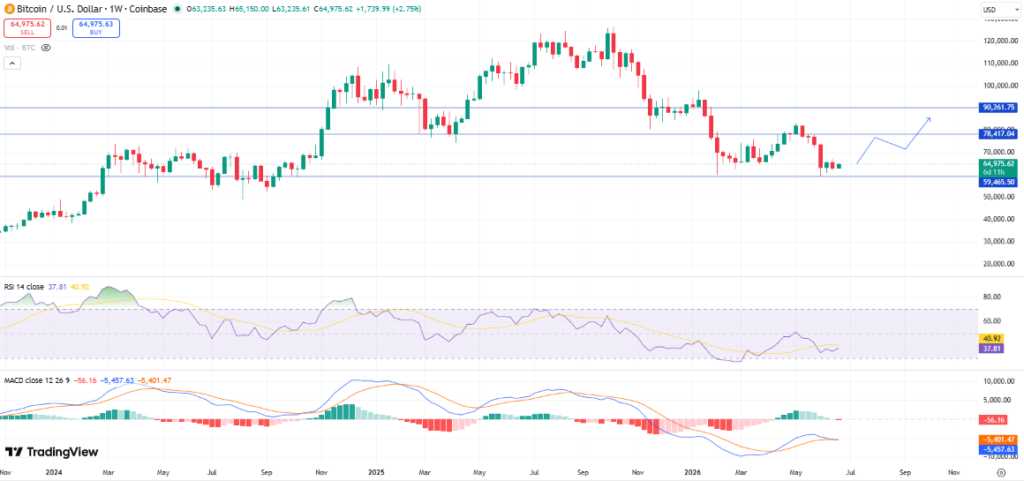
Meanwhile, indicators such as the Relative Strength Index and Moving Average Convergence Divergence indicate a neutral sentiment for the BTC market. The 14-day RSI is hovering around 37 levels, while the MACD line aligns with the signal line. However, a red bar has formed on the histogram, indicating signs of selling pressure.

eToro Platform
Best Crypto Exchange
- Over 90 top cryptos to trade
- Regulated by top-tier entities
- User-friendly trading app
- 30+ million users

eToro is a multi-asset investment platform. The value of your investments may go up or down. Your capital is at risk. Don’t invest unless you’re prepared to lose all the money you invest. This is a high-risk investment, and you should not expect to be protected if something goes wrong.
Advertisement


Raymond Munene
Raymond Munene is a crypto content writer who contributes to Crypto2Community. With over three years of experience, he is interested in Bitcoin, Blockchain, and Technical Analysis. Focusing on daily market analysis, his research helps traders and investors alike. His particular interest in cryptocurrency and blockchain aids his audience.
View full profile ›ℹ️About Crypto2Community's Editorial Process
Crypto2Community's editorial policy is centered on delivering thoroughly researched, accurate, and unbiased content. We uphold strict editorial policy and sourcing standards, and each page undergoes diligent review by our team of top crypto industry experts and seasoned editors. This process ensures the integrity, relevance, and value of our content for our readers.